Transportation Planners: Career Profile
Prepare studies for proposed transportation projects. Gather, compile, and analyze data. Study the use and operation of transportation systems. Develop transportation models or simulations.
Featured schools near , edit
What Tasks Do Transportation Planners Do?
The day-to-day responsibilities of transportation planners cover:
- Define regional or local transportation planning problems or priorities.
- Participate in public meetings or hearings to explain planning proposals, to gather feedback from those affected by projects, or to achieve consensus on project designs.
- Prepare reports or recommendations on transportation planning.
- Collaborate with engineers to research, analyze, or resolve complex transportation design issues.
- Recommend transportation system improvements or projects, based on economic, population, land-use, or traffic projections.
- Develop computer models to address transportation planning issues.
- Analyze information related to transportation, such as land use policies, environmental impact of projects, or long-range planning needs.
- Interpret data from traffic modeling software, geographic information systems, or associated databases.
Key Skills and Knowledge
Successful transportation planners combine a mix of skills and domain knowledge.
Most Important Skills
The competencies most important for this role, rated on an importance scale of 0 to 5:
Core Knowledge
Types of Transportation Planners Jobs
This career also goes by job titles like:
- Airway Transportation Systems Specialist (ATSS)
- Fleet Coordinator
- Planner
- Program Officer
- Traffic Analyst
- Transit Planner
- Transportation Analyst
- Transportation Consultant
How Many Transportation Planners Are There?
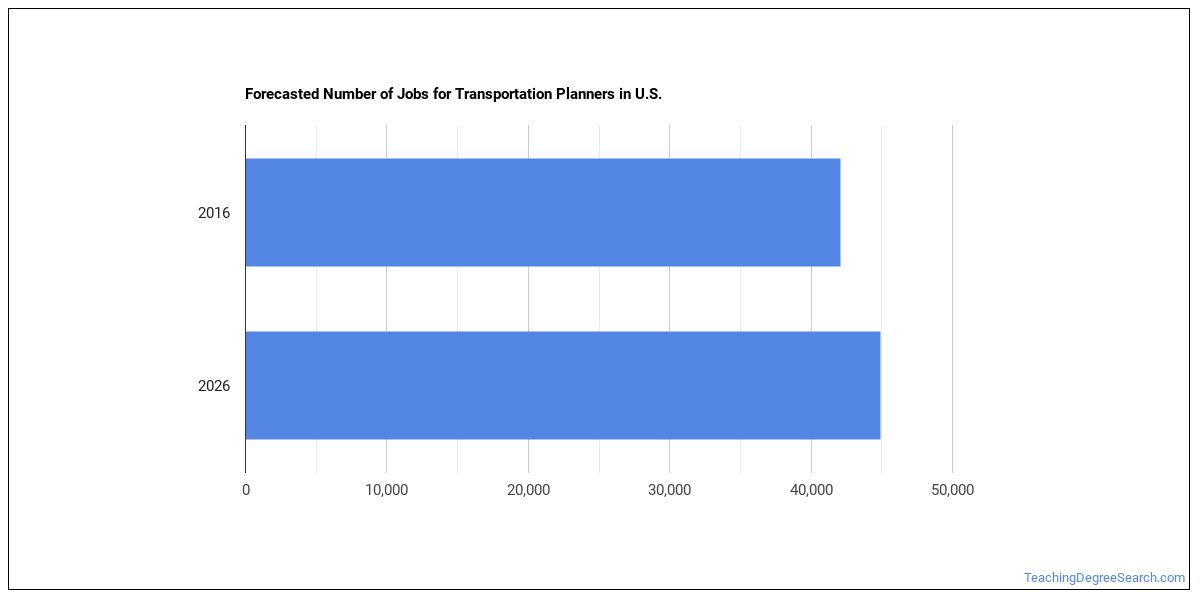
There are roughly 41,813 transportation planners working in the United States today. Employment is projected to grow by +4.1% over the projection horizon.
Transportation Planners Pay
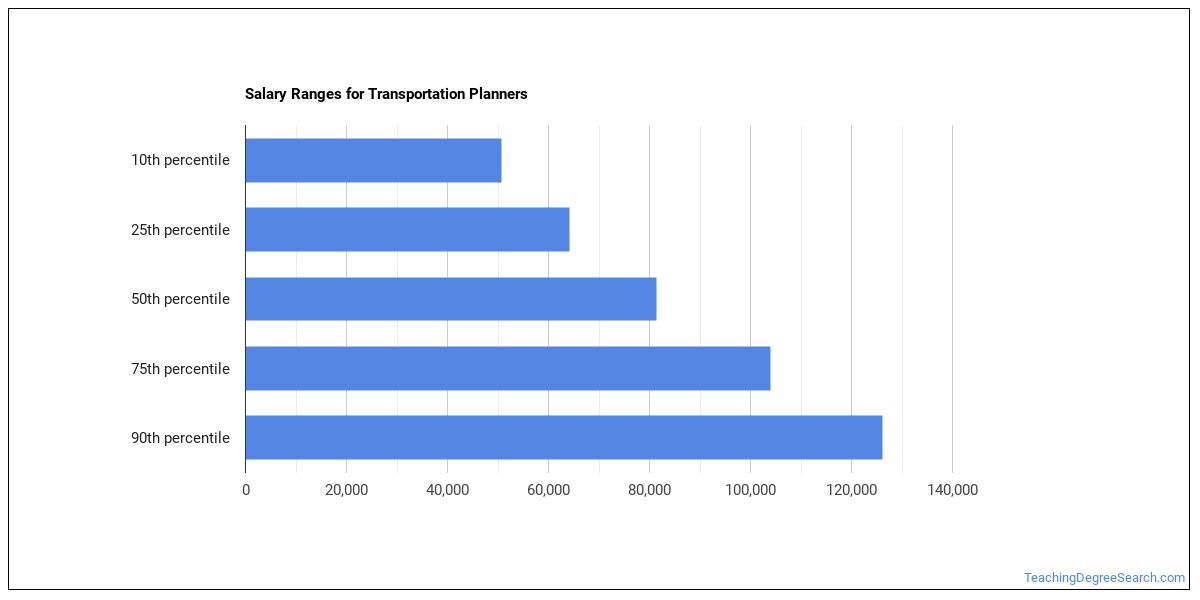
| Statistic | Value |
|---|---|
| Annual median | $50,855 |
| Hourly median | $24.45 |
| 10th percentile | $32,898 |
| 25th percentile | $41,877 |
| 75th percentile | $59,834 |
| 90th percentile | $68,813 |
Wages vary widely based on experience, location, and industry.
Pay by State
| State | Annual median salary |
|---|---|
| Virginia | $144,320 |
| Maryland | $129,750 |
| District of Columbia | $122,320 |
| Washington | $107,100 |
| Massachusetts | $104,770 |
| New York | $102,570 |
| Connecticut | $102,150 |
| Hawaii | $102,000 |
| California | $101,110 |
| Colorado | $101,000 |
| Arizona | $97,360 |
| Oregon | $96,700 |
| New Jersey | $96,360 |
| Texas | $96,210 |
| Minnesota | $95,930 |
| Ohio | $95,860 |
| Alabama | $95,640 |
| Illinois | $94,520 |
| West Virginia | $94,310 |
| Pennsylvania | $93,750 |
| Maine | $89,860 |
| New Mexico | $89,860 |
| Georgia | $89,440 |
| Nevada | $88,750 |
| North Carolina | $87,810 |
| Iowa | $87,590 |
| Mississippi | $86,940 |
| South Carolina | $86,940 |
| Florida | $86,670 |
| Indiana | $84,640 |
| Utah | $84,640 |
| Wyoming | $84,640 |
| Arkansas | $84,640 |
| Alaska | $84,280 |
| Wisconsin | $84,020 |
| Kansas | $82,220 |
| South Dakota | $82,220 |
| New Hampshire | $81,950 |
| Rhode Island | $81,950 |
| Louisiana | $80,490 |
| Missouri | $80,040 |
| Idaho | $79,790 |
| Oklahoma | $79,790 |
| Michigan | $78,960 |
| Montana | $78,770 |
| Kentucky | $78,020 |
| Vermont | $74,990 |
| Puerto Rico | $73,940 |
| North Dakota | $72,550 |
Top-Paying U.S. Regions
Earnings for transportation planners vary by region. The following regions pay the most:
| Region | Median annual wage | Share of U.S. jobs | Location quotient |
|---|---|---|---|
| Middle Atlantic | $114,601 | 25.4% | 6.08 |
| Southeast | $107,184 | 30.4% | 2.34 |
| Far Western US | $100,923 | 13.0% | 1.00 |
| Southwest | $94,936 | 9.9% | 0.80 |
| New England | $93,575 | 2.7% | 0.81 |
| Rocky Mountains | $93,344 | 3.6% | 1.00 |
| Great Lakes | $90,440 | 9.2% | 0.82 |
| Plains States | $87,901 | 5.3% | 1.03 |
Where the Jobs Cluster
| Metro area | State | Median annual wage | Employment |
|---|---|---|---|
| Kennewick-Richland, WA | WA | $178,810 | 60 |
| Washington-Arlington-Alexandria, DC-VA-MD-WV | DC | $137,610 | 7,050 |
| Harrisburg-Carlisle, PA | PA | $127,280 | 100 |
| Baltimore-Columbia-Towson, MD | MD | $125,820 | 1,060 |
| Charlottesville, VA | VA | $118,830 | 360 |
| Dayton-Kettering-Beavercreek, OH | OH | $117,960 | 710 |
| Virginia Beach-Chesapeake-Norfolk, VA-NC | VA | $115,340 | 580 |
| Wilmington, NC | NC | $114,490 | 30 |
Industry Breakdown
The largest employers of transportation planners are found across these industries:
| Industry | Employment | Median annual wage |
|---|---|---|
| Professional, Scientific, and Technical Services | 4,870 | $104,310 |
| Educational Services | 4,520 | $83,100 |
| Management of Companies and Enterprises | 1,610 | $171,320 |
| Health Care and Social Assistance | 490 | $66,260 |
| Other Services (except Public Administration) | 450 | $80,760 |
| Wholesale Trade | 80 | $85,070 |
| Manufacturing | 50 | $66,570 |
| Information | 40 | $134,250 |
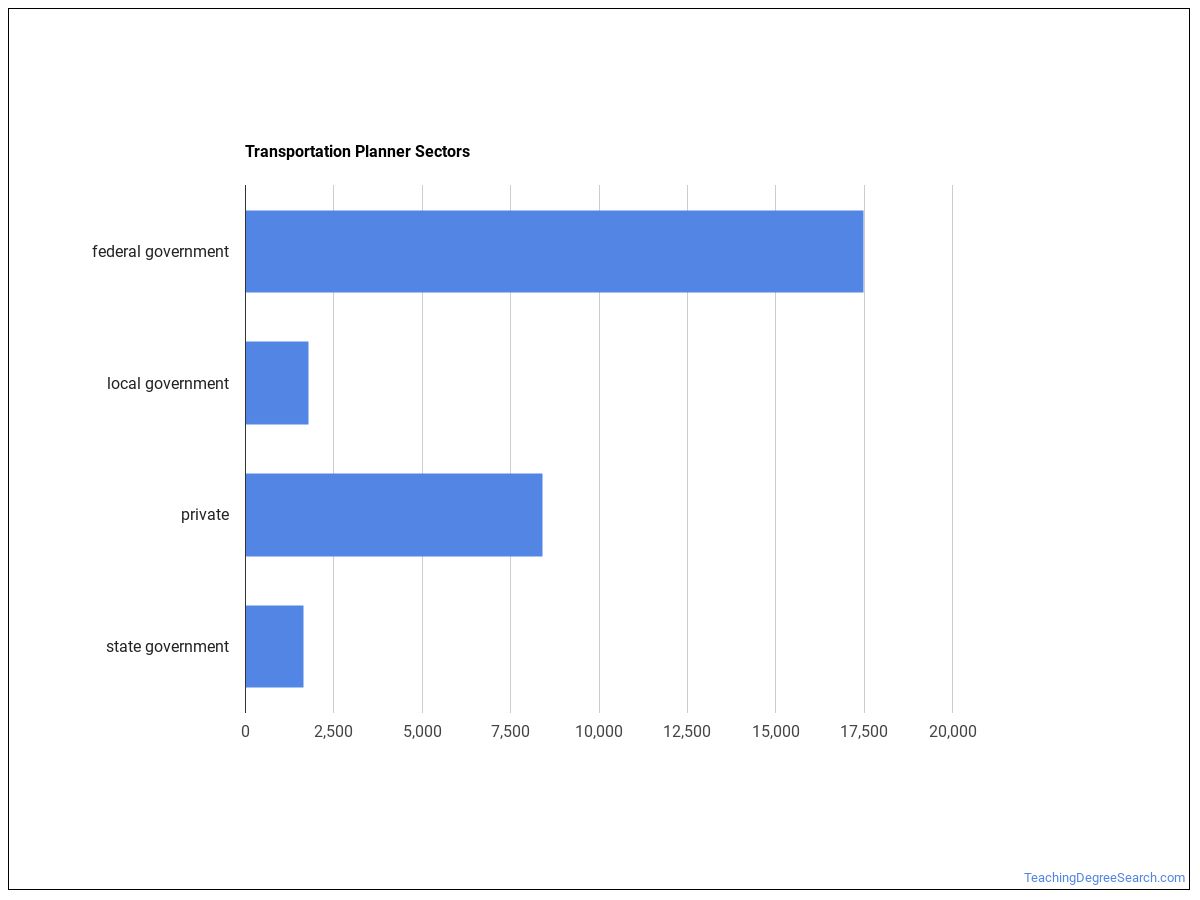
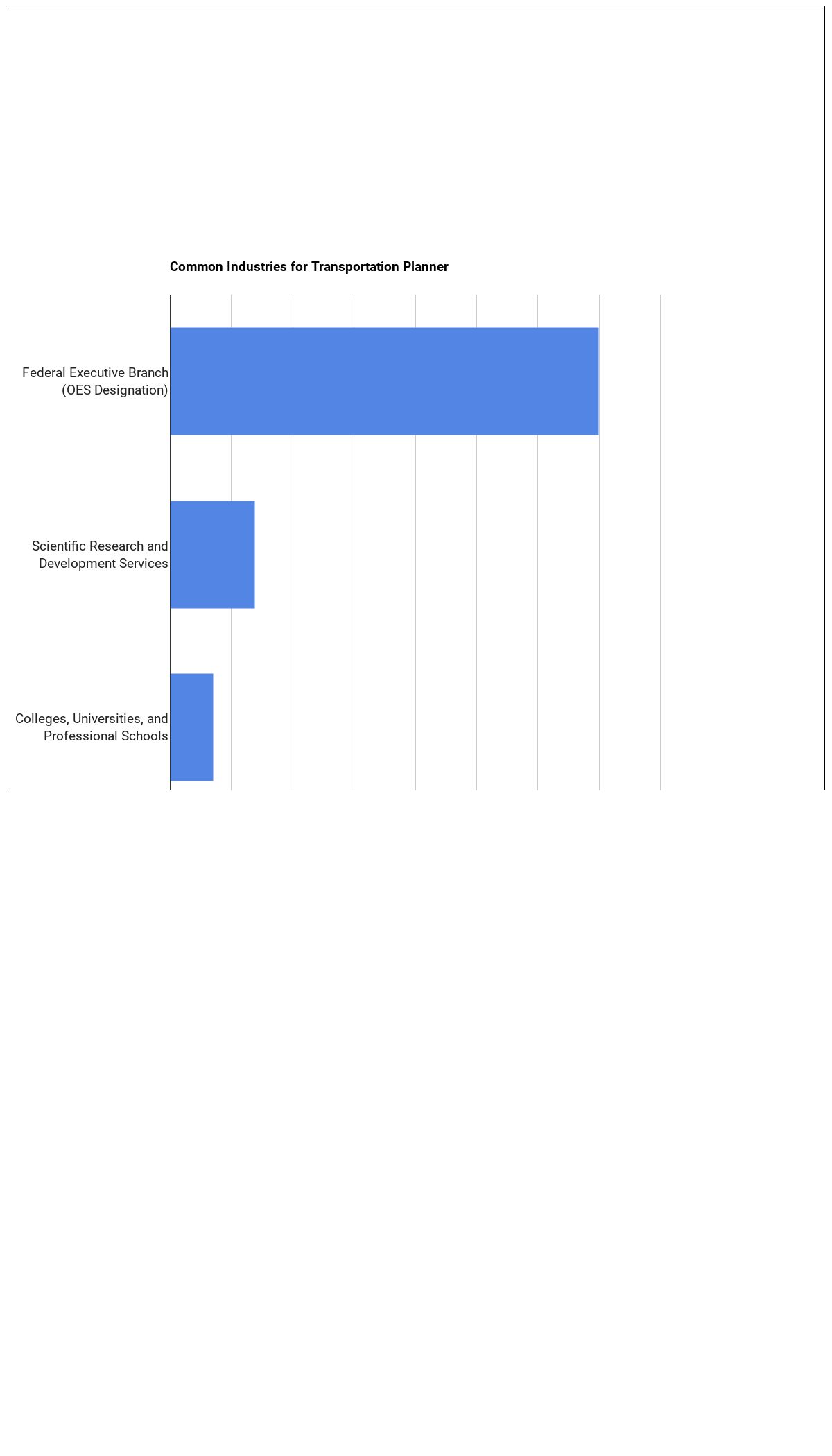
The table below shows some of the most common industries where those employed in this career field work.
Software Transportation Planners Use
- Document management software: Adobe Acrobat (hot technology)
- Graphics or photo imaging software: Adobe Illustrator (hot technology)
- Desktop publishing software: Adobe InDesign (hot technology)
- Graphics or photo imaging software: Adobe Photoshop (hot technology)
- Computer aided design CAD software: Autodesk AutoCAD (hot technology)
- Computer aided design CAD software: Autodesk AutoCAD Civil 3D (hot technology)
- Computer aided design CAD software: Bentley MicroStation (hot technology)
- Geographic information system: ESRI ArcGIS software (hot technology)
- Analytical or scientific software: IBM SPSS Statistics (hot technology)
- Data base user interface and query software: Microsoft Access (hot technology)
- Spreadsheet software: Microsoft Excel (hot technology)
- Office suite software: Microsoft Office software (hot technology)
What the Workplace Is Like
The on-the-job environment of transportation planners reflects the following characteristics:
- Face-to-Face Discussions with Individuals and Within Teams
- Telephone Conversations
- Spend Time Sitting
- Work With or Contribute to a Work Group or Team
Education and Training
Typical transportation planners positions require a bachelor’s degree as the typical entry-level education. The role falls in Considerable Preparation Needed (Job Zone 4), indicating the level of preparation typically expected.
Related Careers
Similar Occupations
- Transportation, Storage, and Distribution Managers (Primary-Short)
- Brownfield Redevelopment Specialists and Site Managers (Supplemental)
- Logisticians (Primary-Short)
- Logistics Engineers (Primary-Short)
- Logistics Analysts (Primary-Long)
- Project Management Specialists (Primary-Long)
- Management Analysts (Supplemental)
- Sustainability Specialists (Supplemental)
Where to Study
Aspiring transportation planners often complete programs in:
Education
5 programs across 1 majors
Sources
Data on this page comes from the following authoritative sources:
- U.S. Bureau of Labor Statistics — Occupational Employment and Wage Statistics (OEWS) for employment and wage data by state and industry.
- BLS Employment Projections for total employment and growth forecasts.
- O*NET (Occupational Information Network) for skills, knowledge, tasks, work activities, work context, technology, and education-zone data.
SOC code: 19-3099.01 (Social Scientists and Related Workers, All Other).

TeachingDegreeSearch.com provides higher-education, college and university, degree, program, career, salary, and other helpful information to students, faculty, institutions, and other internet audiences. Presented information and data are subject to change. Inclusion on this website does not imply or represent a direct relationship with the company, school, or brand. Information, though believed correct at time of publication, may not be correct, and no warranty is provided. Contact the schools to verify any information before relying on it. Financial aid may be available for those who qualify. The displayed options may include sponsored or recommended results, not necessarily based on your preferences.
© TeachingDegreeSearch.com – All Rights Reserved.