Teaching for Gifted & Talented at Converse University
What traits are you looking for in a school for Teaching for Gifted & Talented , consider the program at Converse University. The following information will help you decide if it is a good fit for you.
Converse University is located in Spartanburg, SC.
In the most recent year for which we have data, 4 teaching for gifted & talented degrees were awarded at Converse University.
Featured schools near , edit
Studying Online at Converse University
Online coursework is an option at Converse University. Among 1,787 students, 161 (9%) studied exclusively online and 545 (30%) took at least some classes online.
Teaching for Gifted & Talented Rankings at Converse University
Rankings can help you compare Converse University’s Teaching for Gifted & Talented program to other colleges that offer this major.
Master’s-Level Rankings
| Ranking | Scope | Rank |
|---|---|---|
| Best Schools (Quality) | South Carolina | #None |
| Best Schools (Quality) | Southeast (Region) | #None of 9 |
| Best Schools (Quality) | Nationwide | #None of 14 |
| Best Value | South Carolina | #None of 1 |
| Best Value | Southeast (Region) | #None of 25 |
| Best Value | Nationwide | #None of 63 |
Student Demographics & Diversity
Take a look at the composition of Teaching for Gifted & Talented graduates at Converse University, by degree type.
Program-wide, Teaching for Gifted & Talented graduates at Converse University are 75% women (3) and 25% men (1).
Teaching for Gifted & Talented Master’s Program at Converse University
Of the 4 master’s teaching for gifted & talented graduates at Converse University, 75% were women (3) and 25% were men (1).
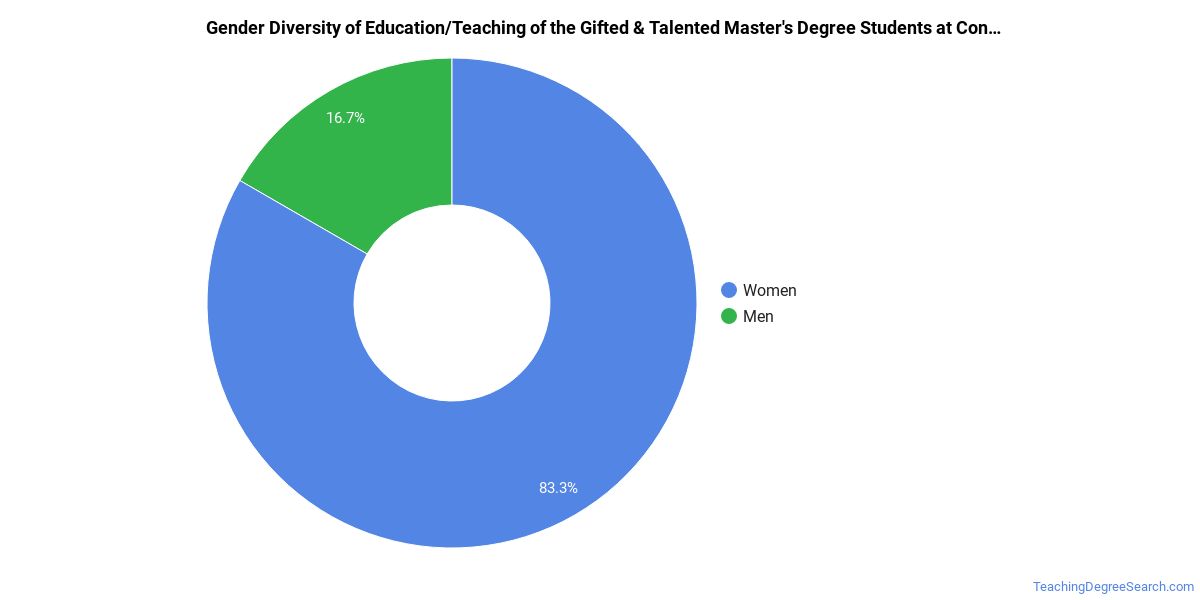
The following table and chart show the race/ethnicity of Teaching for Gifted & Talented master’s degree recipients at Converse University.
| Race / Ethnicity | Number of Graduates |
|---|---|
| White | 3 |
| Black / African American | 1 |
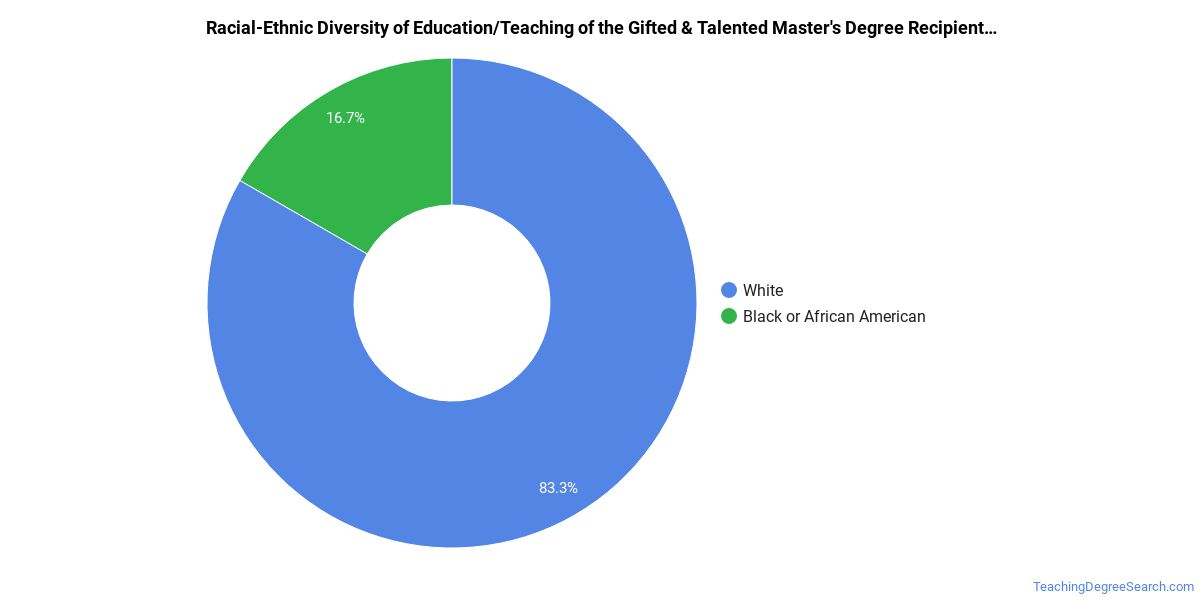
Racial-ethnic minorities make up 25% of Teaching for Gifted & Talented master’s degree recipients at Converse University, above the national average of 21%.*
*The racial-ethnic minorities figure is the total number of graduates minus White, international (nonresident), and unknown-race graduates.
References
- IPEDS — Integrated Postsecondary Education Data System
- U.S. Department of Education — College Scorecard
- O*NET Online (Bureau of Labor Statistics)
- National Center for Education Statistics
More about our data sources and methodologies.

TeachingDegreeSearch.com provides higher-education, college and university, degree, program, career, salary, and other helpful information to students, faculty, institutions, and other internet audiences. Presented information and data are subject to change. Inclusion on this website does not imply or represent a direct relationship with the company, school, or brand. Information, though believed correct at time of publication, may not be correct, and no warranty is provided. Contact the schools to verify any information before relying on it. Financial aid may be available for those who qualify. The displayed options may include sponsored or recommended results, not necessarily based on your preferences.
© TeachingDegreeSearch.com – All Rights Reserved.