Curators in Alabama
Want to work as a Curators in Alabama? Here’s what the data says. Administer collections, such as artwork, collectibles, historic items, or scientific specimens of museums or other institutions. May conduct instructional, research, or public service activities of institution.
What do Curators Make in Alabama?
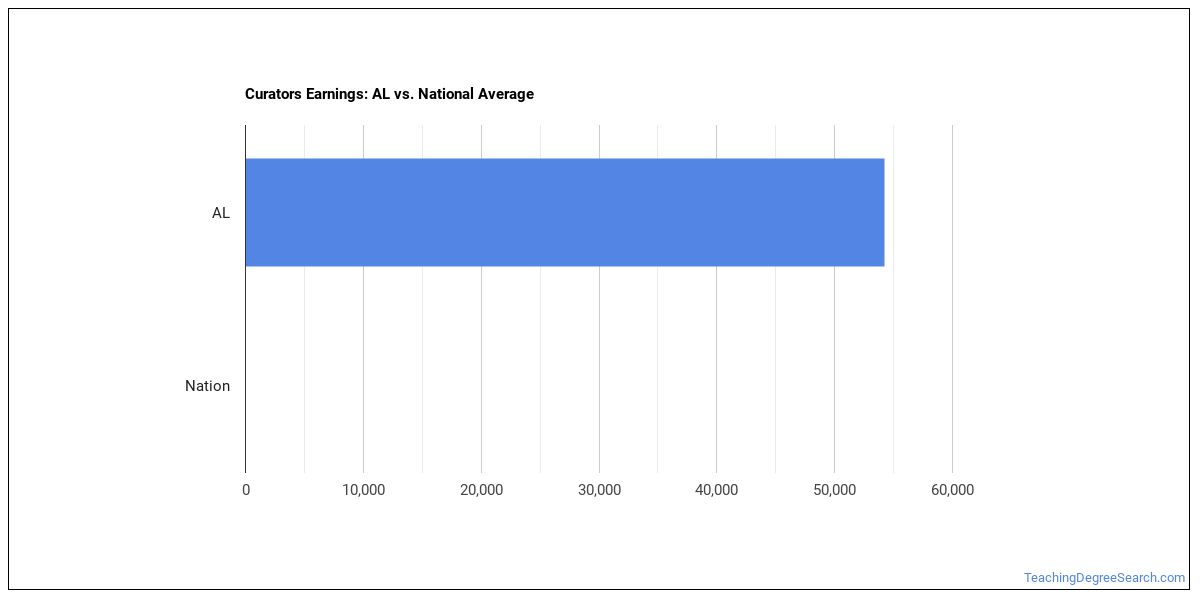
The curators working in Alabama, wages run about $58,390 per year (or roughly $28.07/hour).Earnings range from $38,530 at the 10th percentile to $99,470 at the 90th percentile.
| Wage Statistic | Annual | Hourly |
|---|---|---|
| 10th percentile | $38,530 | $18.52 |
| 25th percentile | $45,480 | $21.87 |
| Median (50th) | $58,390 | $28.07 |
| 75th percentile | $76,440 | $36.75 |
| 90th percentile | $99,470 | $47.82 |

The job concentration index in Alabama compared to the national average — is 1.00.
National Wage Comparison
Nationally, curators earn a median of $79,764 per year ($38.35/hour), lower than the Alabama median.
Employment Outlook
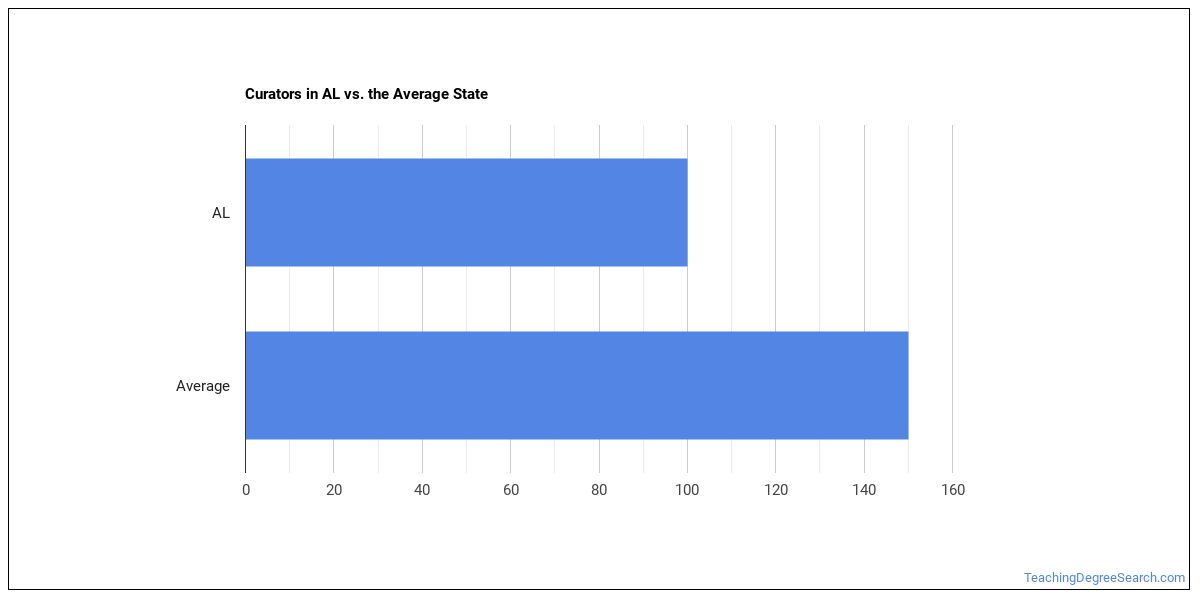
Nationally, total employment in this occupation is 1,493,993 curators in the U.S.. In Alabama alone, around 170 people work in this role. That’s in line with the typical state median of 170.

Top Alabama Metros for Curators
The metro areas below employ the most curators in Alabama.
| Metro Area | Number Employed | Annual Median Salary |
|---|---|---|
| Montgomery, AL | 50 | $52,980 |
| Birmingham, AL | 30 | $75,830 |
Top States for Curators Employment
These states have the highest employment of curators work.
| State | Number Employed |
|---|---|
| New York | 1,270 |
| California | 1,180 |
| Texas | 610 |
| Pennsylvania | 590 |
| Illinois | 570 |
| North Carolina | 570 |
| Florida | 510 |
| Massachusetts | 440 |
| Virginia | 440 |
| Michigan | 360 |
| Colorado | 340 |
| Ohio | 320 |
| Washington | 260 |
| Wisconsin | 250 |
| Georgia | 240 |
| Missouri | 230 |
| Oklahoma | 220 |
| Maryland | 200 |
| Connecticut | 200 |
| Tennessee | 200 |
Highest-Paying States for Curators
The highest-paying states for curators.
| State | Annual Median Salary |
|---|---|
| District of Columbia | $81,990 |
| New York | $78,760 |
| California | $78,710 |
| Massachusetts | $75,980 |
| Rhode Island | $74,690 |
| Connecticut | $73,350 |
| Colorado | $70,100 |
| Nevada | $67,310 |
| Washington | $66,160 |
| New Jersey | $65,930 |
Skills
Top curators skills, rated on an importance scale of 0 to 5:
Knowledge Areas
Important knowledge areas for this occupation, rated on an importance scale of 0 to 5:
Abilities
Top abilities for curators, rated on an importance scale of 0 to 5:
Daily Tasks
Day-to-day, curators typically:
- Plan and organize the acquisition, storage, and exhibition of collections and related materials, including the selection of exhibition themes and designs, and develop or install exhibit materials.
- Develop and maintain an institution's registration, cataloging, and basic record-keeping systems, using computer databases.
- Plan and conduct special research projects in area of interest or expertise.
- Provide information from the institution's holdings to other curators and to the public.
- Negotiate and authorize purchase, sale, exchange, or loan of collections.
- Study, examine, and test acquisitions to authenticate their origin, composition, history, and to assess their current value.
- Inspect premises to assess the need for repairs and to ensure that climate and pest control issues are addressed.
- Write and review grant proposals, journal articles, institutional reports, and publicity materials.
- Design, organize, or conduct tours, workshops, and instructional or educational sessions to acquaint individuals with an institution's facilities and materials.
- Attend meetings, conventions, and civic events to promote use of institution's services, to seek financing, and to maintain community alliances.
- Train and supervise curatorial, fiscal, technical, research, and clerical staff, as well as volunteers or interns.
- Confer with the board of directors to formulate and interpret policies, to determine budget requirements, and to plan overall operations.
Work Activities
- Identifying Objects, Actions, and Events
- Documenting/Recording Information
- Getting Information
- Thinking Creatively
- Organizing, Planning, and Prioritizing Work
- Establishing and Maintaining Interpersonal Relationships
- Making Decisions and Solving Problems
- Communicating with Supervisors, Peers, or Subordinates
- Communicating with People Outside the Organization
- Working with Computers
- Processing Information
- Updating and Using Relevant Knowledge
Tools & Technology
Technologies frequently used: Hot technologies: Adobe Acrobat, Adobe Creative Cloud software, Adobe Illustrator In-demand technologies: Microsoft Excel
Related Careers
Related occupations to curators include:
- Anthropologists and Archeologists
- Historians
- Social Science Research Assistants
- Architecture Teachers, Postsecondary
- Anthropology and Archeology Teachers, Postsecondary
- Area, Ethnic, and Cultural Studies Teachers, Postsecondary
Also Known As
Art Curator, Art Handler, Coin Collector, Collections Curator, Collections Manager, Content Curator, Curator, Data Curator, Digital Curator, Education Curator, Educational Institution Curator, Educational Resource Coordinator, Exhibitions Curator, Exhibits Curator, Field Collector.
References
- U.S. Bureau of Labor Statistics, Occupational Employment and Wage Statistics — https://www.bls.gov/oes/
- O*NET Online — https://www.onetonline.org/
- BLS Employment Projections — https://www.bls.gov/emp/
- O*NET-SOC code: 25-4012.00

TeachingDegreeSearch.com provides higher-education, college and university, degree, program, career, salary, and other helpful information to students, faculty, institutions, and other internet audiences. Presented information and data are subject to change. Inclusion on this website does not imply or represent a direct relationship with the company, school, or brand. Information, though believed correct at time of publication, may not be correct, and no warranty is provided. Contact the schools to verify any information before relying on it. Financial aid may be available for those who qualify. The displayed options may include sponsored or recommended results, not necessarily based on your preferences.
© TeachingDegreeSearch.com – All Rights Reserved.