Farm and Home Management Educators in Oregon
Considering working as a Farm and Home Management Educators in Oregon? Here’s what you need to know. Instruct and advise individuals and families engaged in agriculture, agricultural-related processes, or home management activities. Demonstrate procedures and apply research findings to advance agricultural and home management activities. May develop educational outreach programs. May instruct on either agricultural issues such as agricultural processes and techniques, pest management, and food safety, or on home management issues such as budgeting, nutrition, and child development. Excludes “Dietitians and Nutritionists” (29-1031).
What do Farm and Home Management Educators Make in Oregon?
The farm and home management educators working in Oregon, the typical annual salary is $85,230 per year (or about $40.98/hour).Annual wages span from $57,440 at the 10th percentile to $106,710 at the 90th percentile.
| Wage Statistic | Annual | Hourly |
|---|---|---|
| 10th percentile | $57,440 | $27.61 |
| 25th percentile | $68,610 | $32.98 |
| Median (50th) | $85,230 | $40.98 |
| 75th percentile | $97,080 | $46.68 |
| 90th percentile | $106,710 | $51.31 |

National Wage Comparison
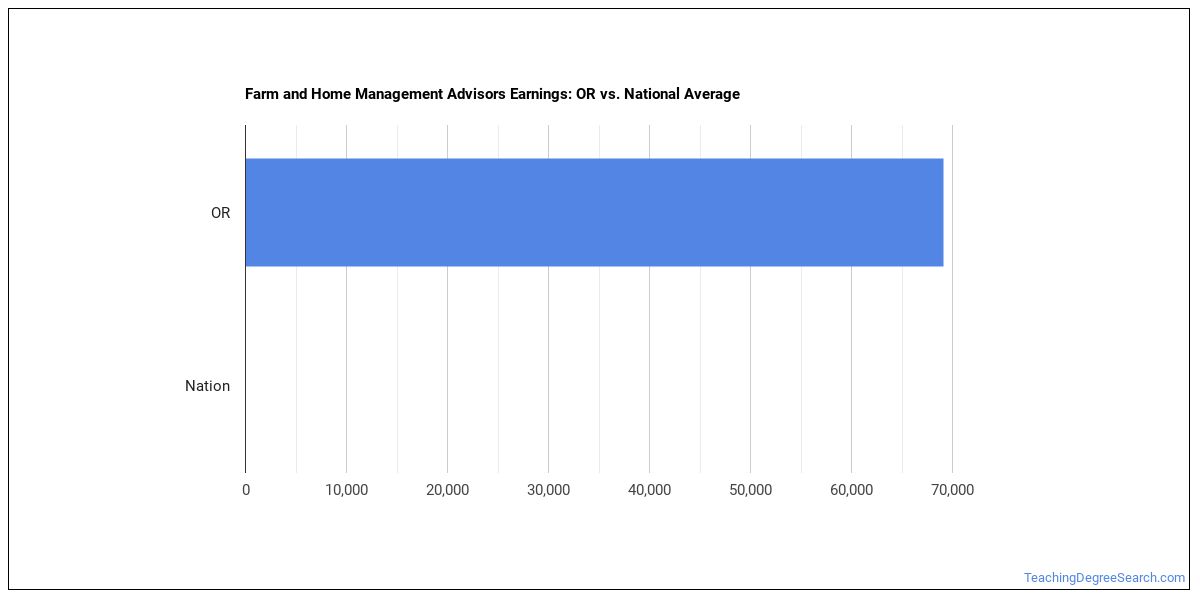
Nationally, farm and home management educators earn a median of $55,950 per year ($26.90/hour), exceeding the Oregon median.
Employment Outlook
There are roughly 1,143,788 farm and home management educators nationwide.

Top States for Farm and Home Management Educators Employment
These states have the highest employment of farm and home management educators work.
| State | Number Employed |
|---|---|
| Florida | 2,900 |
| North Carolina | 750 |
| Wisconsin | 670 |
| Virginia | 600 |
| Puerto Rico | 560 |
| Texas | 480 |
| Pennsylvania | 440 |
| Kentucky | 430 |
| Indiana | 370 |
| Iowa | 360 |
| Michigan | 330 |
| Kansas | 310 |
| Alabama | 260 |
| Georgia | 210 |
| Arkansas | 200 |
| Maryland | 160 |
| California | 140 |
| Wyoming | 120 |
| Nebraska | 120 |
| New Mexico | 110 |
Highest-Paying States for Farm and Home Management Educators
Where farm and home management educators earn the most: farm and home management educators.
| State | Annual Median Salary |
|---|---|
| Idaho | $103,430 |
| California | $98,810 |
| Oregon | $85,230 |
| Maryland | $76,790 |
| Nebraska | $66,270 |
| South Dakota | $64,330 |
| Colorado | $63,560 |
| Indiana | $63,080 |
| Virginia | $62,960 |
| Montana | $62,920 |
Skills
Key farm and home management educators skills, rated on an importance scale of 0 to 5:
Knowledge Areas
Important knowledge areas for this occupation, rated on an importance scale of 0 to 5:
Abilities
The abilities that matter most for farm and home management educators, rated on an importance scale of 0 to 5:
Daily Tasks
Day-to-day, farm and home management educators typically:
- Advise farmers and demonstrate techniques in areas such as feeding and health maintenance of livestock, growing and harvesting practices, and financial planning.
- Conduct classes or deliver lectures on subjects such as nutrition, home management, and farming techniques.
- Collaborate with producers to diagnose and prevent management and production problems.
- Research information requested by farmers.
- Collect and evaluate data to determine community program needs.
- Act as an advocate for farmers or farmers' groups.
- Conduct field demonstrations of new products, techniques, or services.
- Maintain records of services provided and the effects of advice given.
- Prepare and distribute leaflets, pamphlets, and visual aids for educational and informational purposes.
- Schedule and make regular visits to farmers.
- Organize, advise, and participate in community activities and organizations, such as county and state fair events and 4-H Clubs.
- Conduct agricultural research, analyze data, and prepare research reports.
Work Activities
- Communicating with People Outside the Organization
- Updating and Using Relevant Knowledge
- Establishing and Maintaining Interpersonal Relationships
- Performing for or Working Directly with the Public
- Training and Teaching Others
- Communicating with Supervisors, Peers, or Subordinates
- Organizing, Planning, and Prioritizing Work
- Getting Information
- Working with Computers
- Scheduling Work and Activities
- Making Decisions and Solving Problems
- Interpreting the Meaning of Information for Others
Tools & Technology
Common tools and software used in this occupation include: Hot technologies: ESRI ArcGIS software, Microsoft Excel In-demand technologies: Microsoft Office software
Related Careers
Related occupations to farm and home management educators include:
- Farmers, Ranchers, and Other Agricultural Managers
- Management Analysts
- Agricultural Engineers
- Soil and Plant Scientists
- Conservation Scientists
- Range Managers
Also Known As
4-H Agent, 4-H Club Agent, 4-H Youth Development Educator, 4-H Youth Development Specialist, 4-H Youth Educator, Adjunct Instructor, Agricultural Agent, Agricultural Extension Agent, Agricultural Extension Educator, Agriculture Consultant, Agriculture Extension Agent, Agriculture Extension Specialist, CTE Teacher (Career and Technical Education Teacher), Community Educator, Cooking Instructor.
References
- U.S. Bureau of Labor Statistics, Occupational Employment and Wage Statistics — https://www.bls.gov/oes/
- O*NET Online — https://www.onetonline.org/
- BLS Employment Projections — https://www.bls.gov/emp/
- O*NET-SOC code: 25-9021.00

TeachingDegreeSearch.com provides higher-education, college and university, degree, program, career, salary, and other helpful information to students, faculty, institutions, and other internet audiences. Presented information and data are subject to change. Inclusion on this website does not imply or represent a direct relationship with the company, school, or brand. Information, though believed correct at time of publication, may not be correct, and no warranty is provided. Contact the schools to verify any information before relying on it. Financial aid may be available for those who qualify. The displayed options may include sponsored or recommended results, not necessarily based on your preferences.
© TeachingDegreeSearch.com – All Rights Reserved.