Physics Teachers, Postsecondary in Indiana
Considering working as a Physics Teachers, Postsecondary in Indiana? Here’s what you need to know. Teach courses pertaining to the laws of matter and energy. Includes both teachers primarily engaged in teaching and those who do a combination of teaching and research.
What do Physics Teachers, Postsecondary Make in Indiana?
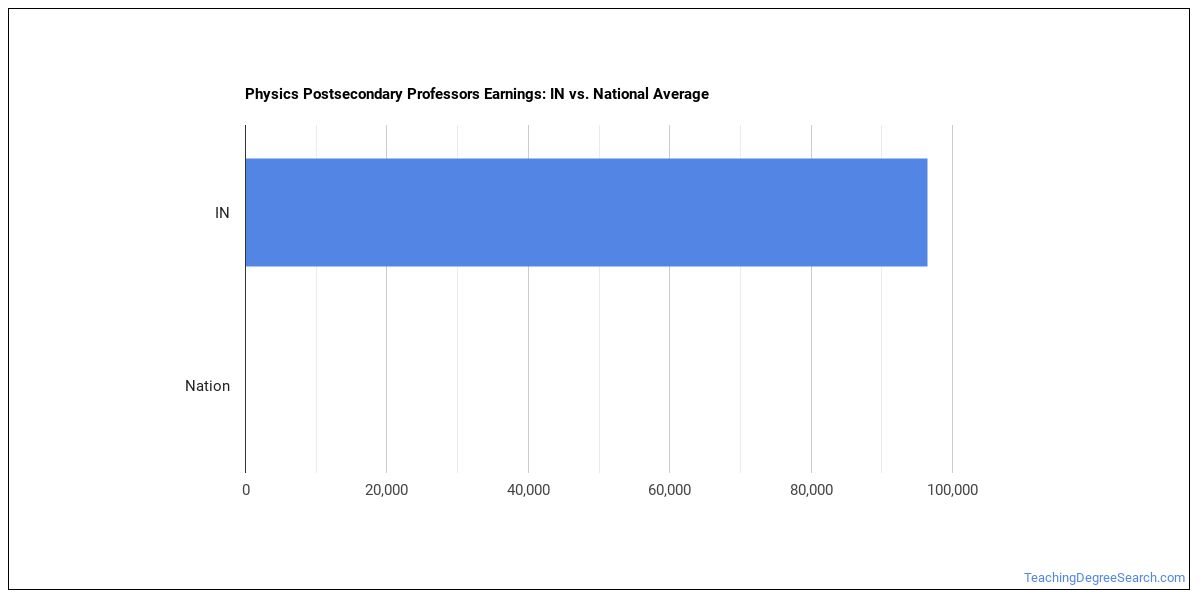
For a physics teachers, postsecondary working in Indiana, the typical annual salary is $101,780 per year.Pay can range from $60,000 at the 10th percentile to $169,080 at the 90th percentile.
| Wage Statistic | Annual | Hourly |
|---|---|---|
| 10th percentile | $60,000 | n/a |
| 25th percentile | $72,690 | n/a |
| Median (50th) | $101,780 | $0.00 |
| 75th percentile | $133,830 | n/a |
| 90th percentile | $169,080 | n/a |

The location quotient — a measure of how concentrated this occupation is in Indiana relative to the national average — is 1.08.
National Wage Comparison
Nationally, physics teachers, postsecondary earn a median of $80,685 per year ($38.79/hour), higher than the Indiana median.
Employment Outlook
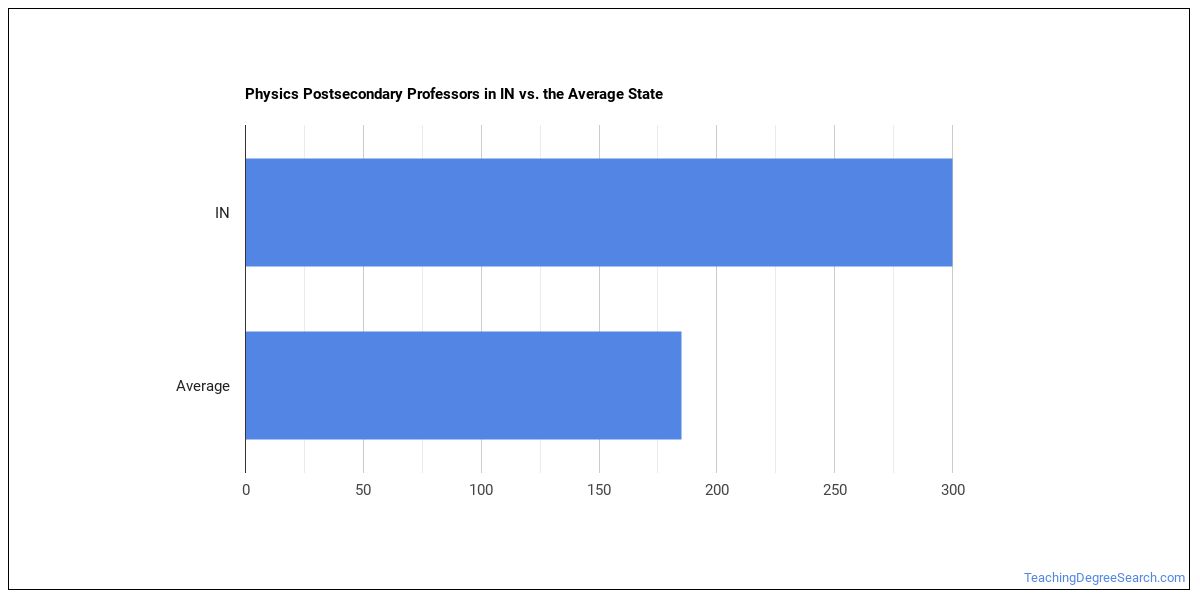
National employment for 363,441 physics teachers, postsecondary nationwide. In Indiana alone, around 300 people work in this role. That’s more than the typical state, which employs around 200 physics teachers, postsecondary.

Top Indiana Metros for Physics Teachers, Postsecondary
These are the Indiana metros with the most physics teachers, postsecondary in Indiana.
| Metro Area | Number Employed | Annual Median Salary |
|---|---|---|
| Indianapolis-Carmel-Greenwood, IN | 40 | $75,980 |
Top States for Physics Teachers, Postsecondary Employment
View the states that employ the most physics teachers, postsecondary work.
| State | Number Employed |
|---|---|
| Texas | 1,340 |
| New York | 1,140 |
| California | 1,070 |
| Pennsylvania | 750 |
| Virginia | 610 |
| New Jersey | 580 |
| Massachusetts | 560 |
| Illinois | 530 |
| Michigan | 440 |
| North Carolina | 430 |
| Ohio | 420 |
| Tennessee | 380 |
| Florida | 350 |
| Indiana | 300 |
| Maryland | 300 |
| Colorado | 300 |
| Washington | 290 |
| Minnesota | 250 |
| Connecticut | 230 |
| Georgia | 230 |
Highest-Paying States for Physics Teachers, Postsecondary
Where physics teachers, postsecondary earn the most: physics teachers, postsecondary.
| State | Annual Median Salary |
|---|---|
| California | $128,190 |
| Arizona | $122,160 |
| Connecticut | $119,310 |
| Montana | $106,330 |
| Michigan | $105,790 |
| New York | $105,360 |
| New Mexico | $104,450 |
| Minnesota | $103,220 |
| Kansas | $102,970 |
| Maryland | $102,810 |
Skills
Top physics teachers, postsecondary skills, rated on an importance scale of 0 to 5:
Knowledge Areas
Core knowledge areas for this occupation, rated on an importance scale of 0 to 5:
Abilities
The abilities that matter most for physics teachers, postsecondary, rated on an importance scale of 0 to 5:
Daily Tasks
Physics Teachers, Postsecondary typically:
- Evaluate and grade students' class work, laboratory work, assignments, and papers.
- Prepare course materials, such as syllabi, homework assignments, and handouts.
- Compile, administer, and grade examinations, or assign this work to others.
- Prepare and deliver lectures to undergraduate or graduate students on topics such as quantum mechanics, particle physics, and optics.
- Maintain regularly scheduled office hours to advise and assist students.
- Supervise undergraduate or graduate teaching, internship, and research work.
- Initiate, facilitate, and moderate classroom discussions.
- Maintain student attendance records, grades, and other required records.
- Plan, evaluate, and revise curricula, course content, course materials, and methods of instruction.
- Supervise students' laboratory work.
- Keep abreast of developments in the field by reading current literature, talking with colleagues, and participating in professional conferences.
- Collaborate with colleagues to address teaching and research issues.
Work Activities
- Training and Teaching Others
- Working with Computers
- Updating and Using Relevant Knowledge
- Interpreting the Meaning of Information for Others
- Making Decisions and Solving Problems
- Analyzing Data or Information
- Thinking Creatively
- Identifying Objects, Actions, and Events
- Processing Information
- Getting Information
- Organizing, Planning, and Prioritizing Work
- Communicating with Supervisors, Peers, or Subordinates
Tools & Technology
Technologies frequently used: Hot technologies: Autodesk AutoCAD, C In-demand technologies: Learning management system LMS
What Major Will Prepare You For This Career?
Related college programs include:
- Teacher Education Subject Specific
Featured schools near , edit
Related Careers
Other careers like physics teachers, postsecondary include:
- Computer and Information Research Scientists
- Mathematicians
- Bioengineers and Biomedical Engineers
- Nanosystems Engineers
- Nanotechnology Engineering Technologists and Technicians
- Biochemists and Biophysicists
Also Known As
Acoustics Teacher, Adjunct Instructor, Adjunct Physics Instructor, Adjunct Physics Professor, Adjunct Professor, Aerodynamics Professor, Aerodynamics Teacher, Assistant Professor, Associate Professor, Astrophysics Professor, Astrophysics Teacher, Atomic Physics Professor, Atomic Physics Teacher, Ballistics Professor, Ballistics Teacher.
References
- U.S. Bureau of Labor Statistics, Occupational Employment and Wage Statistics — https://www.bls.gov/oes/
- O*NET Online — https://www.onetonline.org/
- BLS Employment Projections — https://www.bls.gov/emp/
- O*NET-SOC code: 25-1054.00

TeachingDegreeSearch.com provides higher-education, college and university, degree, program, career, salary, and other helpful information to students, faculty, institutions, and other internet audiences. Presented information and data are subject to change. Inclusion on this website does not imply or represent a direct relationship with the company, school, or brand. Information, though believed correct at time of publication, may not be correct, and no warranty is provided. Contact the schools to verify any information before relying on it. Financial aid may be available for those who qualify. The displayed options may include sponsored or recommended results, not necessarily based on your preferences.
© TeachingDegreeSearch.com – All Rights Reserved.